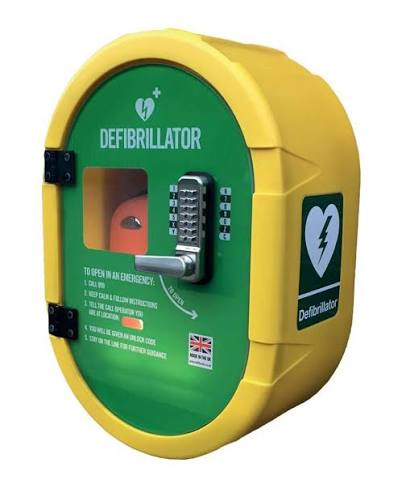
Public-access defibrillators can save lives following a cardiac arrest. This page explains what to do in an emergency, how to access a defibrillator and where to find further information and training.
What is a defibrillator
A defibrillator, also known as an Automated External Defibrillator or AED, is a device designed to help someone who is in cardiac arrest.
You do not need to be medically trained to use one.
Once switched on, the defibrillator gives clear spoken and visual instructions. It analyses the person’s heart rhythm and will only advise or deliver a shock when one is required.
What should I do if someone collapses?
If someone is unconscious and not breathing normally:
Call 999 immediately.
The ambulance service call handler will tell you what to do and guide you through CPR.
If another person is nearby, the call handler may ask them to collect the nearest available defibrillator while CPR continues.
Do not delay CPR while searching for a defibrillator.
When the defibrillator arrives:
- Switch it on.
- Follow the spoken and visual instructions.
- Expose the person’s chest.
- Attach the pads as shown on the diagrams.
- Stand clear when instructed.
- Continue CPR whenever the machine tells you to do so.
Keep following the instructions until the ambulance service arrives or the person shows signs of life.
How do I access a locked defibrillator?
Many public-access defibrillators are stored in secure cabinets.
If the cabinet is locked, you must call 999 to gain access.
The ambulance service can identify the nearest appropriate registered defibrillator and, where the cabinet is locked, will provide the access code required to open it.
The access code is not intended to be publicly displayed.
In an emergency:
Call 999 first.
Tell the call handler that the person is unconscious and not breathing normally.
They will guide you through CPR, identify the nearest suitable registered defibrillator and provide the cabinet access information where required.
Do not leave the patient simply to search for a defibrillator before calling 999.
Where is my nearest defibrillator?
Public-access defibrillators throughout the UK can be registered on The Circuit – the national defibrillator network.
The Circuit provides ambulance services with information including:
- the location of a defibrillator;
- when it is available;
- whether it is ready for use; and
- how it can be accessed.
The British Heart Foundation also operates DefibFinder, which uses information from The Circuit to allow people to familiarise themselves with registered defibrillators in their area.
Find a defibrillator:
www.defibfinder.uk
DefibFinder is useful for learning where local defibrillators are situated.
However, during an emergency, always call 999 first. DefibFinder does not provide cabinet access codes.
Defibrillators in the Caersws area
Caersws Community Council is responsible for a number of public-access defibrillators within the community, while other local organisations also provide units.
The Council carries out regular checks on the defibrillators it manages and records their status through the national defibrillator system.
[LOCAL DEFIBRILLATOR MAP AND LOCATION LIST HERE, should we include all the other station, seasons café etc.?]
Because locations and availability can change, residents should use DefibFinder for the latest registered information.
What is The Circuit?
The Circuit is the UK’s national defibrillator network.
It connects information supplied by defibrillator owners and Guardians with ambulance services.
Registering a defibrillator means ambulance-service call handlers can see important information about it when dealing with a suspected cardiac arrest.
This includes its location, availability and access arrangements.
Do I need training?
No.
Public-access defibrillators are designed to be used by members of the public, including people who have never received formal AED training.
The machine talks you through what to do.
However, learning CPR and becoming familiar with a defibrillator beforehand can give people greater confidence if they ever have to respond to a real emergency.
Free CPR training
The British Heart Foundation provides a free online course called RevivR.
The course takes around 15 minutes and covers:
- recognising cardiac arrest;
- calling 999;
- performing CPR; and
- using a defibrillator.
You can complete it using a phone or tablet and a cushion to practise CPR.
[Learn CPR in 15 minutes with BHF RevivR]
Caersws Community Council would encourage residents to consider completing the course.
Local CPR and Defibrillator Training
Caersws Community Council has previously supported local defibrillator training.
The Council is considering whether further community CPR and AED awareness sessions could be arranged locally.
These would give residents the opportunity to practise CPR and become familiar with a training defibrillator in a non-emergency environment.
Residents interested in future training are encouraged to contact the Community Council via clerk@caerswscommunitycouncil.gov.uk
Remember
If someone is unconscious and not breathing normally:
CALL 999 – START CPR – USE A DEFIBRILLATOR AS SOON AS ONE IS AVAILABLE.
If the defibrillator is in a locked cabinet:
CALL 999 – THE AMBULANCE SERVICE WILL PROVIDE THE ACCESS CODE. Knowing what to do could help save a life.